
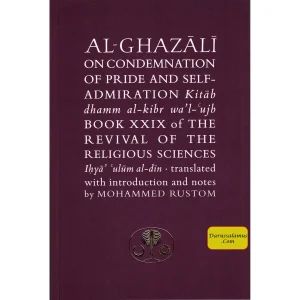
Al-Ghazali on the Condemnation of Pride and Self-Admiration
"Al-Ghazali on the Condemnation of Pride and Self-Admiration" is the 29th book in Imam al-Ghazali's monumental work, Ihya’ Ulum al-Din (The Revival of the Religious Sciences). In this treatise, al-Ghazali delves into two fundamental spiritual ailments: pride (kibr) and self-admiration (ujb)
The book is divided into two parts:
-
Pride (Kibr): Al-Ghazali examines how pride is condemned in the Qur'an, its symptoms, outward manifestations, and seven causes, with self-admiration being the root cause. He emphasizes humility as the antidote and provides examples of true and false humility
-
Self-Admiration (Ujb): Al-Ghazali defines self-admiration, explores its inward manifestations, and discusses how it leads to negligence, delusion, and complacency. He offers remedies for each of these conditions
The translator, Mohammed Rustom, is an Associate Professor of Islamic Studies at Carleton University and has provided a lucid and accessible English rendition of al-Ghazali's original Arabic text. His translation is noted for its scholarly accuracy and readability, making this profound work accessible to a wider audience.
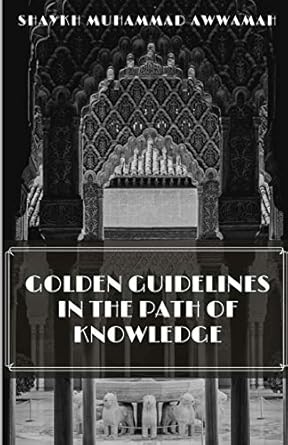
Golden Guidelines in the Path of Knowledge
Golden Guidelines in the Path of Knowledge is a concise yet profound booklet that encapsulates the essential advice and wisdom of Shaykh Muhammad Awwamah, a renowned Syrian scholar and muhaddith. Originally delivered as a lecture, this work addresses the etiquettes, responsibilities, and spiritual dimensions of seeking Islamic knowledge. It serves as a guide for students, scholars, and anyone committed to the pursuit of sacred knowledge, emphasizing sincerity, humility, and adherence to the Sunnah.
The book is appreciated for its clarity and depth, offering guidance that is both practical and spiritually enriching. It's particularly beneficial for those embarking on the journey of Islamic studies, providing a roadmap to navigate the challenges and responsibilities that come with the pursuit of knowledge.
The Book of Certainty: The Sufi Doctrine of Faith, Vision and Gnosis
"The Book of Certainty" is a profound yet accessible introduction to Sufi metaphysics, authored by Dr. Martin Lings under the pen name Abu Bakr Siraj ad-Din. Drawing from Islamic mysticism, the book elucidates the three degrees of certainty
-
'Ilmu 'l-yaqin (Knowledge of Certainty)
-
'Aynu 'l-yaqin (Eye of Certainty)
-
Haqqu 'l-yaqin (Truth of Certainty)
Through vivid metaphors and traditional imagery, Lings explores themes such as the nature of the soul, the symbolism of light and darkness, and the journey of spiritual realization. The work is praised for its clarity and depth, making complex Sufi concepts accessible to readers.
The Book of Wisdoms
This classic Sufi text is a collection of 264 aphorisms that delve into the spiritual journey of the soul, emphasizing themes like divine wisdom, self-purification, and the relationship between the seeker and the Divine. The aphorisms are concise yet profound, offering guidance for those on the spiritual path.

The Real Treatment for Droughts and Plagues
In this concise treatise, Maulana Thanvi (RA) explores the Islamic perspective on natural disasters, offering guidance rooted in the Qur'an and Sunnah. He underscores that such events are tests from Allah, meant to purify believers and draw them closer to Him. The book provides practical advice on maintaining faith, engaging in supplication, and upholding ethical conduct during times of hardship.