Hadeeth
English Kitaab
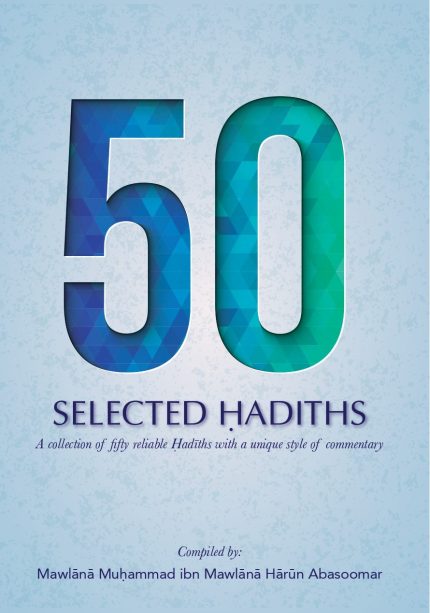
50 Selected Hadith
Hadith memorization is as old as Quran memorization, and has remained in the Ummah since its inception.
In this light, many Madrasahs have included the subject of ‘Hifz Hadith’ in their curriculum.
This collection of fifty concise Ḥadīths is based on authenticity coupled with variety in the topics that are discussed.
The format was set to suit teenage learners, and to instill in them the noble practices that are advocated in the selected Hadiths. This book is highly recommended for every higher grade Maktab learner, as well as beginners in a Dărul ‘Ulum

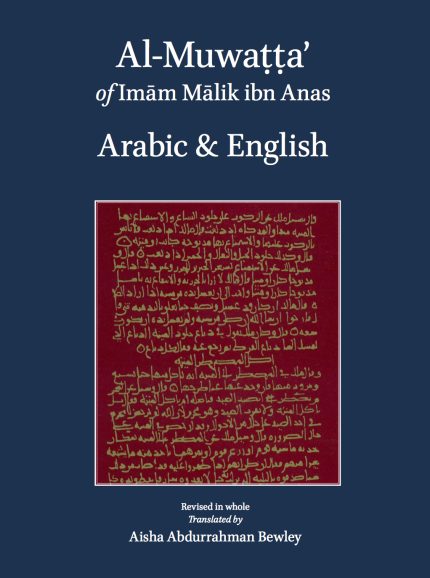
Al Muwattah Of Imam Malik
It is the first of the sahih works, long pre-dating al-Bukhari and Muslim.
Al-Bukhari regarded the transmission of Imam Malik narrating from Nafi‘ from ‘Abdullah ibn ‘Umar from the Messenger of Allah, may Allah bless him and grant him peace, as being ‘the Golden Chain of Transmission’.
Abu Dawud, whose Sunan is another of the Six Books of hadith, added “then Malik, from az-Zuhri, from Salim, from his father [i.e. Ibn ‘Umar], then Malik, from Abu z-Zinad, from al-A‘raj, from Abu Hurayrah”, without mentioning anything from anyone other than Malik.
Ibn Hajar said, “… some imams say that they are unqualifiedly the soundest of isnads, such as az-Zuhri i.e. the hadith which az-Zuhri – who is better known as Ibn Shihab – narrated from Salim i.e. transmitting to him from Salim ibn ‘Abdullah ibn ‘Umar from his father. The school of Ahmad [ibn Hanbal] and Ibn Rahwayh is that this is unqualifiedly the soundest chain of transmission”.
Adh-Dhahabi held that, “The soundest of chains of transmission are those from az-Zuhri from Sa‘id ibn al-Musayyab from Abu Hurayrah” which are abundant in the Muwatta. Then those which come from Abu’z-Zinād from al-A‘raj from Abū Hurayrah.”
Ash-Shāfi‘ī said, “After the Book of Allah, there is no book on the face of the earth sounder than the book of Mālik.”
‘Alā’ ad-Dīn Maghlaṭāy al-Ḥanafī said, “The first person to compile the ṣaḥīḥ was Mālik.”
Ibn Ḥajar said, “The book of Mālik is sound by all the criteria that are demanded as proofs in the mursal, munqaṭi‘ and other types of transmission.”
As-Suyūṭī followed Ibn Ḥajar’s judgement and said, “It is absolutely correct to say that the Muwaṭṭa’ is sound (ṣaḥīḥ) without exception.”
Al-Bukhārī and Muslim transmitted most of its ḥadīths and included them in their Ṣaḥīḥ collections. The authors of the rest of the six books, the Imām of the ḥadīth scholars, Aḥmad ibn Ḥanbal, and others did the same.
In addition, the Muwaṭṭa’ contains a record of the practice (‘amal) of the people of Madīnah of the first generations, a transmission of the ethos that permeated the city, and Imām Mālik’s painstaking clarification of the Sunna, the ḥadīths, the practice and legal judgements.

Al-Shaafi Risalah
Written in the second Islamic century by al-Imam al-Shafi’i (d. 204AH/820AD), the founder of one of the four Sunni schools of law. This important work gives the fundamental principles of Islamic jurisprudence and its influence continues to the present day. During the early years of the spread of Islam, the exponents of Islamic legal doctrine were faced with the problems raised by ruling and administering a diverse and rapidly growing empire. In Medina and Kufa, as well as other cities of early Muslim rule, schools of law had to be developed, but it took the genius of Muhammad b. Idris al-Shafi’i, born in the year 150AH/767AD, to establish the principles by which the various legal doctrines could be synthesised into a coherent system. In the Risala, which laid down the basis for such a synthesis, al-Shafi’i established the overriding authority, next only to the Qur’an, of the Sunna or example of the Prophet Muhammad as transmitted in the traditions.
An Explanation Of The Bayquni Poem
Description From The Publisher
I begin with praise, sending prayers upon
Muhammad S.A.W, the best of Prophets sent
From the most noble of sciences is the science of Hadith. It is the key to unlock the Sunna of the Prophet S.A.W through his words, actions, qualities and tacit approvals. Allah says: “Follow him so that you may be guided.” The Messenger of Allah S.A.W said: “May Allah illuminate the one who hears my speech, understands it and conveys it.”
For this reason, the scholars of Hadith have spared no effort to establish the principles by which to verify narrations and deduce—with the utmost precision—what can and cannot be attributed to the guide of mankind S.A.W. Facilitating this quest for the beginning student, the erudite Imam ʿUmar al-Bayquni al-Dimashqi (d. 1080 H.) succinctly defined thirty-four categories of Hadith in his famous thirty-four verses of poetry.
Completed, with goodness they are sealed!
Numerous commentaries upon this treatise followed, of which one of the most sought after in recent times is the masterpiece we have before us, written by the master [hafiz] of Hadith and exegete of the Qurʾan, Imam ʿAbdallah Sirajuddin al-Husayni. In his unique and eloquent style, the saintly Imam takes the reader on an illuminating path of learning, guiding him towards the guidance of the most beloved S.A.W.
Bulughul Maram Attainment Of The Objective
Contemporary Challenges In The Feild Of Hadeeth
The widespread assaults on the Mubarak Hadith of Rasulullah (sallallahu ‘alayhi wasallam) are no secret to any person of this field. Whilst these attacks progressively increase, the ummah on the other hand, is faced with the predicament of “internal cracks” and widespread disarray among so called “Hadith Scholars”.
Al-‘Allāmatul Muhaddith, Shaykh Muhammad ‘Awwamah (hafizahullāh) addressed these two contemporary challenges in the field of Hadith in a paper that he presented to a gathering of the most senior Scholars of the world. These words of advice are of a seasoned expert of Hadith, who has made remarkable contributions to this field.
Although this paper was delivered over ten years ago, its contents are extremely important, and are actually more applicable today than when it was delivered.