
Al-Ghazali on the Condemnation of Pride and Self-Admiration
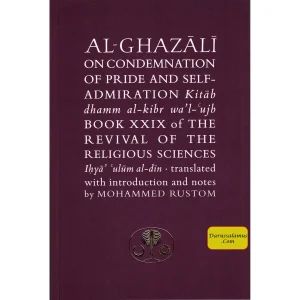
"Al-Ghazali on the Condemnation of Pride and Self-Admiration" is the 29th book in Imam al-Ghazali's monumental work, Ihya’ Ulum al-Din (The Revival of the Religious Sciences). In this treatise, al-Ghazali delves into two fundamental spiritual ailments: pride (kibr) and self-admiration (ujb)
The book is divided into two parts:
-
Pride (Kibr): Al-Ghazali examines how pride is condemned in the Qur'an, its symptoms, outward manifestations, and seven causes, with self-admiration being the root cause. He emphasizes humility as the antidote and provides examples of true and false humility
-
Self-Admiration (Ujb): Al-Ghazali defines self-admiration, explores its inward manifestations, and discusses how it leads to negligence, delusion, and complacency. He offers remedies for each of these conditions
The translator, Mohammed Rustom, is an Associate Professor of Islamic Studies at Carleton University and has provided a lucid and accessible English rendition of al-Ghazali's original Arabic text. His translation is noted for its scholarly accuracy and readability, making this profound work accessible to a wider audience.
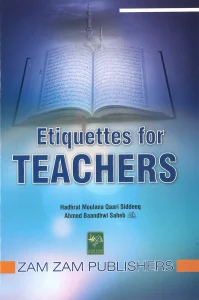
Etiquettes for Teachers
Etiquettes for Teachers is a concise guide outlining ten essential etiquettes for educators, rooted in the Qur'an and Sunnah. Authored by the esteemed Hadhrat Maulana Qari Siddeeq Ahmad Baandwi (RA), the book emphasizes the spiritual and moral responsibilities of teachers. It serves as a valuable resource for educators aiming to align their teaching practices with Islamic principles.
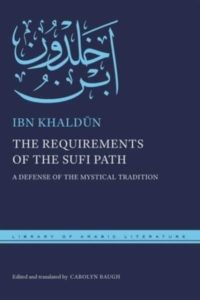
Ibn Khaldun on Sufism: Remedy for the Questioner in Search of Answers
"Ibn Khaldun on Sufism: Remedy for the Questioner in Search of Answers" is the first-ever English translation of Ibn Khaldun's treatise Shifa’ al-Sa’il li-Tahdhib al-Masa’il. In this work, Ibn Khaldun addresses a prevalent debate in fourteenth-century Andalusia regarding the necessity of a spiritual guide (shaykh) for the Sufi path. He examines whether reliance on written texts suffices for spiritual guidance or if direct mentorship is essential
The treatise delves into the nature of Sufism, its practices, and its role within Islamic spirituality. Ibn Khaldun, renowned for his contributions to sociology and historiography, applies his analytical acumen to assess the legitimacy and requirements of the Sufi tradition. His insights offer a nuanced understanding of Sufism's place in Islamic thought and practice
This translation by Yumna Ozer provides readers with access to Ibn Khaldun's perspectives on Sufism, shedding light on his views and the intellectual milieu of his time.

O Traveller to the Sacred City of Madinah Munawwarah
O Traveller to the Sacred City of Madinah Munawwarah is a concise guide designed to assist and educate Muslims journeying to the blessed city of Madinah. Compiled by Abdul Rahman ibn Hussein Kolia Roshnee, this treatise provides authentic information drawn from the Qur'an, Hadith, and the practices of the Noble Companions. It serves as a valuable resource for pilgrims, offering insights into the spiritual significance and etiquettes associated with visiting Madinah.
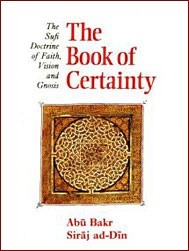
The Book of Certainty: The Sufi Doctrine of Faith, Vision and Gnosis
"The Book of Certainty" is a profound yet accessible introduction to Sufi metaphysics, authored by Dr. Martin Lings under the pen name Abu Bakr Siraj ad-Din. Drawing from Islamic mysticism, the book elucidates the three degrees of certainty
-
'Ilmu 'l-yaqin (Knowledge of Certainty)
-
'Aynu 'l-yaqin (Eye of Certainty)
-
Haqqu 'l-yaqin (Truth of Certainty)
Through vivid metaphors and traditional imagery, Lings explores themes such as the nature of the soul, the symbolism of light and darkness, and the journey of spiritual realization. The work is praised for its clarity and depth, making complex Sufi concepts accessible to readers.